





Canada's credit unions (CUs) have a rare opportunity: they can manage the transition beyond Forge as a technology replacement, or use it as the foundation for a more connected member experience and a stronger growth strategy.
Adrian Moise, CEO & Founder of Aequilibrium
For many institutions, selecting a new digital banking platform or replacing MemberDirect or Forge is one of the largest digital initiatives they will undertake this decade. The immediate work is demanding: select and configure the new digital banking platform, connect it to the core, integrate third-party partners, migrate members, communicate to members, train employees, address technical debt, and prepare the contact center for launch.
Those tasks are essential, but they are not the full opportunity. A member does not experience platform architecture. They experience a credit union across a sequence of moments: searching for advice, comparing products, opening an account, signing in, moving money, and receiving an offer that is relevant to their needs. If those moments remain disconnected after the migration, the credit union may have replaced its technology without materially improving the relationship.
The member journey begins before sign-in
Digital banking programs naturally focus on the authenticated experience. That is where balances, transfers, payments, and account servicing live. Yet the member journey often starts much earlier, through Google, AI search, a campaign, a product page, or a financial question on the credit union’s public website.
If the public website is generic, difficult to navigate, or disconnected from account opening, members feel the break before they ever reach the new banking platform. They may find a product but struggle to understand whether it fits their needs. They may begin an application and have to repeat information or input information that is already present within their profile. They may move from a modern website into a completely different interface, tone, and navigation model.
The public website and the authenticated platform therefore need to be designed as parts of one experience. Product discovery should lead naturally into onboarding. The brand, content, and navigation should remain familiar across the handoff. Once the member signs in, the institution should continue the conversation with the context and permissions needed to serve that member responsibly.
A connected experience supports growth
A well-planned transition can improve four outcomes that matter to credit union leaders.
Keep existing members.
Members will compare the new experience with the one they used yesterday, not with the vendor’s product roadmap. Familiar journeys, reliable everyday banking, accessible design, and a carefully managed first login reduce avoidable frustration. Migration success begins with preserving member confidence while providing new valued functionality.
Grow existing relationships.
A member’s needs are rarely visible in digital banking alone. The core, Customer Relationship Management (CRM) system, and service history may show a much fuller relationship. Connecting those sources allows a credit union to offer useful guidance, timely follow-up, and relevant products instead of presenting the same generic promotions to everyone.
Attract younger and new members.
For Gen Z and other digitally oriented prospects, the experience begins on a phone, and expectations are set quickly. As a Credit Union, you will have less time to make a positive first impression and will be compared in minutes to other providers. Clear product information, simple account opening, and a consistent transition into everyday banking are part of the value proposition. A strong mobile app cannot compensate for a fragmented acquisition journey.
Turn data into a better experience.
Core banking, CRM, account opening, payments, content, and analytics systems often hold different pieces of the member relationship. The goal is not to move all of that data into one system. It is to connect the right data, with the right permissions and governance, so each channel can respond appropriately to the member’s context.
Integration is a member experience decision
It is tempting to treat integration as a technical workstream that sits behind the visible experience. In practice, many of the most important member outcomes depend on it. A clean onboarding handoff depends on connections among the website, identity, account opening, and core systems. A relevant next-best action depends on trusted data from the CRM and core. Consistent support depends on employees seeing enough context to understand what the member has already done.
This is also why a platform-by-platform approach creates limits. When the website, digital banking platform, core and CRM are planned separately, each may meet its own requirements while the member still encounters repetition, inconsistent information and dead ends between channels.
Credit unions should define the priority journeys first, then decide how platforms, data and operating processes will support them. That changes the conversation from whether an individual system works to whether the complete member experience works.
AI becomes useful after the foundations are connected
Artificial intelligence can help a credit union tailor content, identify service needs, create automated workflows, and guide members toward appropriate next steps. But AI does not solve fragmented journeys or unreliable data. Applied too early, it can simply make disconnected systems produce faster, less consistent interactions.
The practical sequence is straightforward. Establish trusted data, clear consent, and governance. Connect the journeys and channels that matter most. Then introduce AI where it can improve a defined member outcome, such as helping a prospect find the right account, assisting an employee with the next service step, or tailoring educational content to a member’s situation.
Questions leaders should ask now
Before migration plans harden around platform tasks, executive teams should test whether the program can answer a broader set of questions:
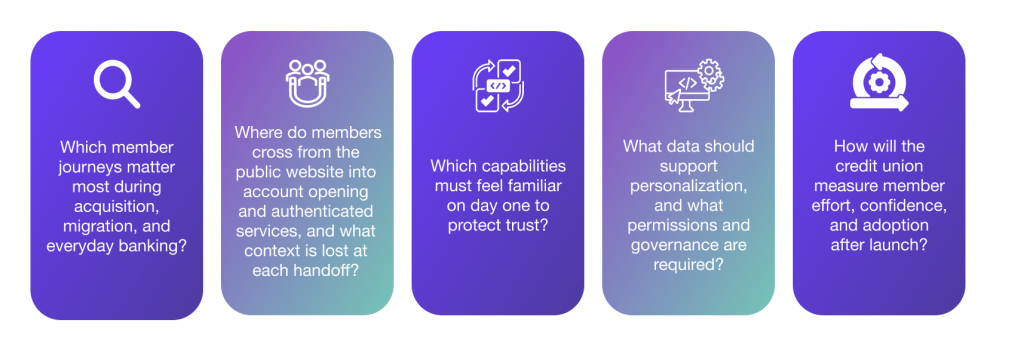
These questions do not expand the program for the sake of scope. They help leaders make deliberate choices about where the migration should preserve continuity, where it should remove friction, and where it should create new value. This will also allow a Credit Union to decouple the workstream for expedited delivery but remain in sync with an overall member journey and a connected delivery experience.
The opportunity beyond Forge
The strongest outcome is not a collection of modern systems. It is a member experience that moves coherently from discovery to onboarding, banking and advice, supported by connected data and prepared employees.
That requires credit-union leadership across experience design, integration, testing, governance, communications, and operational readiness. The digital banking platform is central to the transition, but the investment’s value will depend on how well the institution connects everything around it.
Credit unions that approach a digital banking platform or Forge transition this way can protect the trust they have already earned while creating a digital experience that supports future growth. That is the real opportunity beyond Forge.
Heading to Momentum? Let’s compare notes on your Digital Banking or planned Forge transition roadmap and the member journeys it needs to support.
