





AI is changing the way NPCs (Non-Player Characters) behave in virtual reality.
For a long time, NPCs were mostly scripted characters. They could guide the user, repeat instructions, trigger animations, and follow a fixed path. That works for simple experiences, but it becomes limited when the goal is training real human behavior.
In a training scenario, people do not always say the expected sentence. They hesitate, interrupt, give incomplete answers, ask unexpected questions, or react emotionally. A traditional NPC usually cannot handle this well.
This is where AI becomes important.
AI allows NPCs to listen, understand context, respond naturally, and adapt to the user’s behavior. Instead of only following a dialogue tree, the NPC can become part of the training itself.
Why This Matters in VR Training
Virtual reality already creates a strong sense of presence. The user is not watching a character on a screen. They are standing in front of someone, hearing their voice, seeing their body language, and feeling the pressure of the moment.
This makes AI NPCs especially useful for training. They can be used in situations such as:
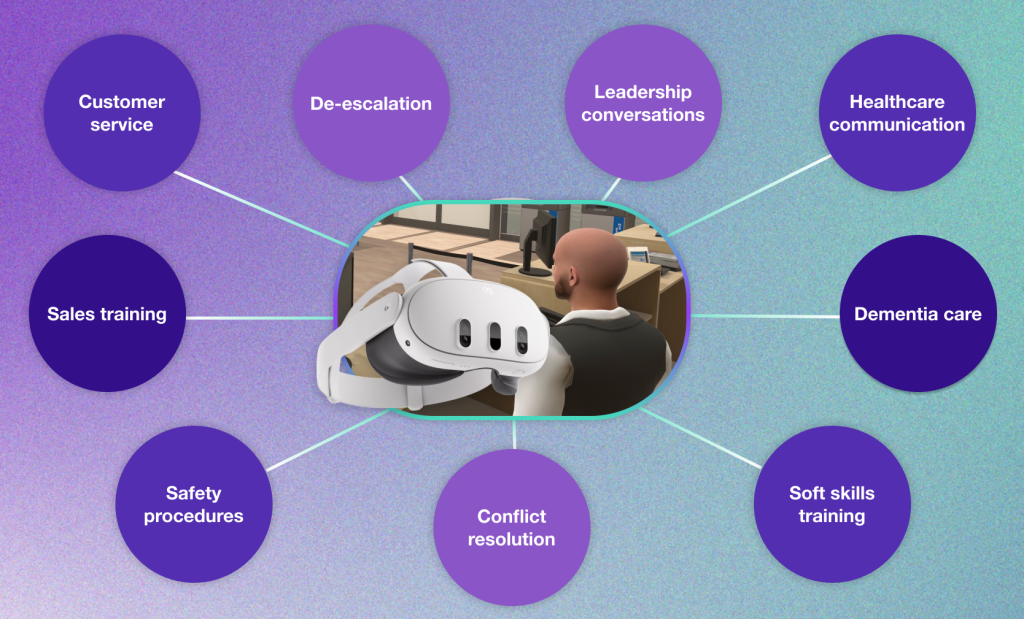
In these cases, the user is not only learning information. They are practicing how to communicate.
That is the real value.
An AI NPC can challenge the user, show doubt, ask follow-up questions, react to mistakes, and create a different conversation every time. This makes the VR training feel more natural and less predictable.
The Balance: Human, But Controlled
The biggest challenge is balance.
The NPC needs to feel human enough to create immersion, but controlled enough to keep the training correct.
If the NPC is too scripted, the conversation feels fake. If the NPC is too free, it can leave the scenario, invent information, or make the training unreliable.
A strong AI NPC needs clear rules:
Who the character is
What the character knows
What the character wants
What the character should not say
How the character reacts to user mistakes
When the scenario should move forward
When the user has succeeded or failed
This is why a good prompt helps, but it is not enough.
The AI also needs structured context, memory, validation, and testing.
Personality Makes the NPC Feel Real
A generic NPC feels artificial.
The character needs a clear personality. For example, the NPC can be:
Calm or impatient
Confused or confident
Polite or resistant
Insecure or direct
Talkative or quiet
This personality should appear in the voice, words, facial expression, posture, and animation.
If the NPC starts as insecure but suddenly becomes confident for no reason, the illusion breaks. If the NPC says it is calm but the animation looks angry, the user will notice.
In VR, small details matter.
A pause, a look, a gesture, or a change in tone can make the NPC feel much more believable.
Memory Makes the Conversation Coherent
For an AI NPC to feel human, it needs to remember what matters. It does not need to remember everything. It needs to remember the important parts of the current training session.
For example:
What the user already explained
Which questions were already answered
Which objections are still unresolved
What information was already revealed
What the NPC is currently feeling
This memory should be controlled and structured.
Instead of sending the entire conversation to the AI every time, the system can keep a simple state:
![{ "stage": "objection", "emotion": "concerned", "user_showed_empathy": true, "revealed_information": ["price concern"], "next_action": "ask for clearer explanation" }](/wp-content/uploads/2026/06/Humanazing-Aequilibrium-06-04-2026_02_08_PM-1.png)
The Main Technical Challenges
Creating AI NPCs for VR is not only an AI task. It is also a real-time engineering challenge. The system needs to handle:
Microphone input
Speech-to-text
AI response generation
Text-to-speech
Audio playback
Avatar animation
Network stability
Session state
Performance on VR devices
One of the biggest problems is latency.
If the NPC takes too long to answer, the user may feel that the system froze. But if the NPC answers instantly, it can also feel robotic.
The solution is not only speed. The experience needs good timing.
While the AI is processing, the NPC can show a listening expression, maintain eye contact, breathe, or use a subtle thinking animation. This keeps the scene alive while the system prepares the response.
The AI Can Make Mistakes
AI NPCs have limits.
They can misunderstand the user. They can repeat themselves. They can generate wrong information. They can become too helpful. They can become too difficult. They can leave the intended role if the system is not well protected.
For training, this is serious.
The NPC should not invent prices, policies, medical information, product features, or scenario facts. The user should not learn something wrong because the AI created an answer that sounded confident but was incorrect.
To reduce this risk, the system should use approved information, clear scenario rules, validation, and fallback responses. The NPC should also know when to say that it does not know.
Not Everything Should Be Controlled by AI
AI should make the NPC feel natural, but the full experience should not depend only on AI. Some parts should remain controlled by the system:
Scenario stages
Training objectives
Completion rules
Safety limits
Score calculation
Required user behaviors
Available animations
Session start and end
Error handling
This creates a safer and more stable experience.
A good approach is to let AI handle the conversation, while the backend control the training structure.
What Makes an AI NPC Useful for Training
A good AI NPC does not simply talk well. It helps the user practice.
It can:
Ask for clarification
Show doubt when the answer is weak
React positively to empathy
Push back when the user gives an incomplete solution
Reveal information gradually
Keep the user inside the scenario
Give the system data for feedback and evaluation
This is what separates an AI character from a training tool.
The goal is not just immersion. The goal is learning.
Final Overview
AI is humanizing NPCs by making them more responsive, contextual, and believable.
In VR, this is powerful because the user feels present with the character. The conversation is no longer just text or buttons. It becomes a real interaction with timing, voice, emotion, and pressure.
For training experiences, AI NPCs can make simulations more realistic, scalable, and adaptive. They allow users to practice difficult conversations in a safe environment, make mistakes, repeat scenarios, and receive feedback.
But the best results come from balance.
AI brings natural behavior. VR brings presence. Game logic brings control. Training design brings purpose.
When these parts work together, NPCs stop feeling like scripted objects and start feeling like virtual humans built for learning.
